Recently, the research group of Luyan Sun at the Institute for Interdisciplinary Information Sciences, Tsinghua University, in collaboration with the groups of Chang-Ling Zou and Ming Li at the University of Science and Technology of China and Haifeng Yu at the Beijing Academy of Quantum Information Sciences, published a research paper titled "Principles of optics in Fock space for the scalable manipulation of large quantum states" in Nature Physics. The team proposes a novel quantum state manipulation framework named "Fock-space optics," which introduces fundamental principles of classical optics, including propagation, refraction, lensing, interference, and imaging, into high-dimensional quantum state spaces, and successfully validates the framework experimentally using superconducting quantum devices. This work establishes a deep connection between classical optics and quantum state evolution, offering a new design paradigm for the scalable control of large-scale quantum systems with thousands of photons and advanced bosonic information processing.
From Solving the Schrödinger Equation to "Designing Optical Circuits"
For over three centuries, classical optics has relied on well-established principles such as refraction, lensing, and interference to design powerful optical systems without the need to solve complex Maxwell's equations, greatly advancing modern optical technologies. In contrast, the manipulation of high-dimensional quantum states in the infinite-dimensional Fock space of bosonic cavities, a crucial resource for quantum computing, communication, simulation, and metrology, has long lacked an intuitive design language analogous to classical optics. As the photon number increases, the cost of conventional numerical optimization grows steeply, severely limiting the deterministic control of large-photon-number quantum states.
The research team sets out to address a fundamental question: can we establish a simple, intuitive, and scalable design method for high-dimensional quantum states, analogous to designing optical circuits in classical optics? They discover that under weak pumping at large photon numbers, the coupling between adjacent Fock states becomes approximately uniform, and the quantum-state evolution equation closely resembles the classical paraxial wave equation, allowing the quantum state to be viewed as a beam propagating in a "synthetic dimension" of photon number.
Building on this insight, the team proposes the "Fock-space optics" control framework, which maps the concept of classical optical elements onto quantum-state manipulation: different control pulses correspond to different "optical elements," and the quantum state propagates, refracts, focuses, and interferes in Fock space just like a beam of light. They construct an experimental platform based on a superconducting three-dimensional microwave cavity and systematically demonstrate a series of fundamental optical phenomena in Fock space within a range of up to 180 photons (Fig. 1).
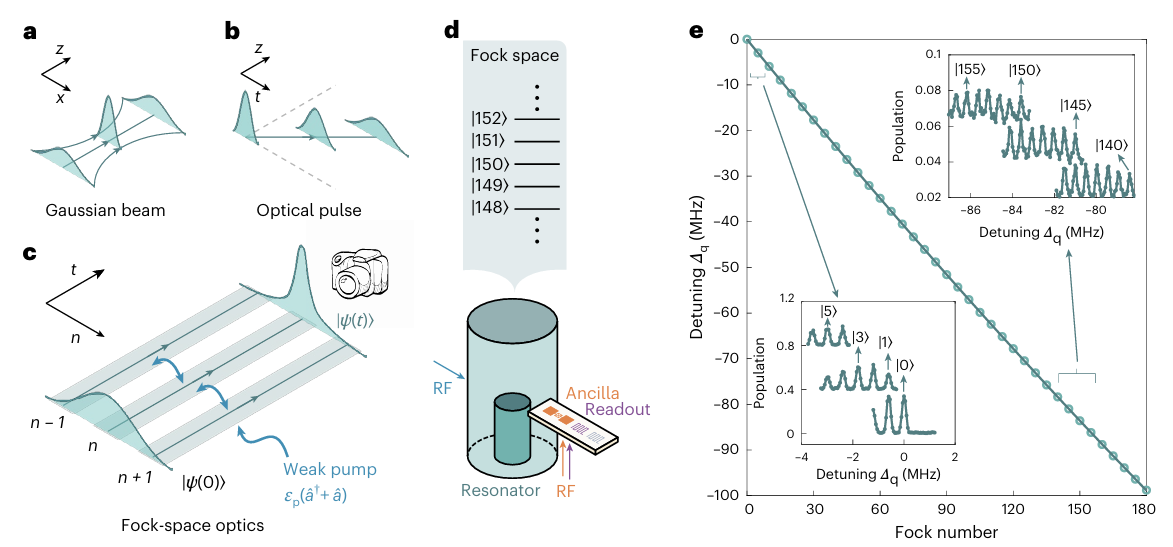
Fig. 1: Concept and experimental implementation of Fock-space optics
"Building Optical Systems" in the Quantum World
The research team employs a coherent state as an analog of a parallel light beam. By accumulating a linear phase under detuning or a quadratic phase under Kerr nonlinearity, they respectively realize a prism and a lens in Fock space, demonstrating refraction, focusing, and divergence of quantum states (Fig. 2). By combining the Fock-space lens with post-selection, they achieve efficient preparation of large-photon-number Fock states, setting new world records in both photon number and preparation success rate. Notably, the success rate theoretically does not decrease significantly with increasing photon number.
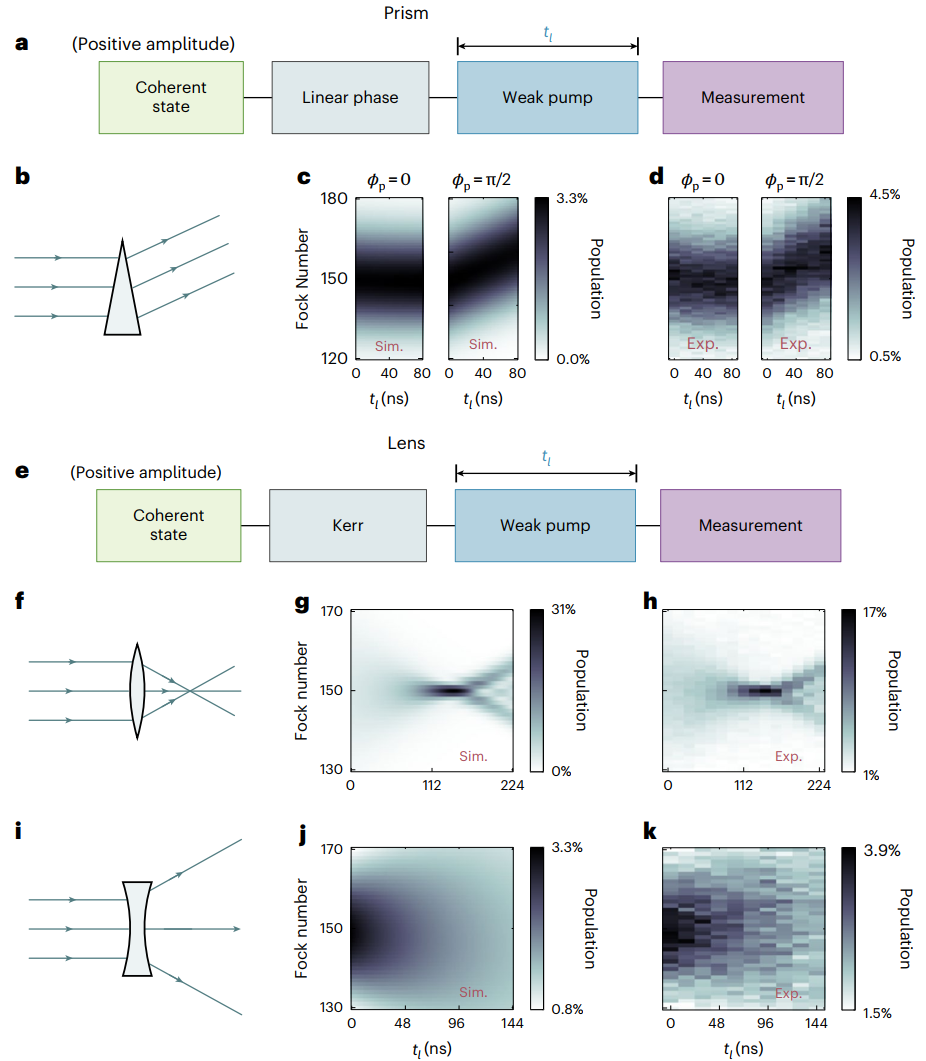
Fig. 2: Prism and lens elements in Fock space
Building on this foundation, the team further demonstrates Fock-space versions of several classical optical experiments. In the quantum "Newton's prism experiment" (Fig. 3), the combination of a prism and a lens in Fock space causes identical initial states to focus onto different Fock states depending on the pump frequency. In the Fock-space "double-slits interference experiment" (Fig. 4), they use a "phase-space slingshot" method to prepare double Gaussian-distributed quantum states that act as virtual double slits. By varying their relative phase or separation, the resulting fringe shifts and spacings are found to be consistent with classical double-slit interference. Finally, by introducing weak pump before and after the lens to simulate object and image distances, they show that when the imaging condition is satisfied, the quantum state can be flipped to form an inverted, magnified real image, with the magnification approximately equal to the image-to-object distance ratio (Fig. 5).
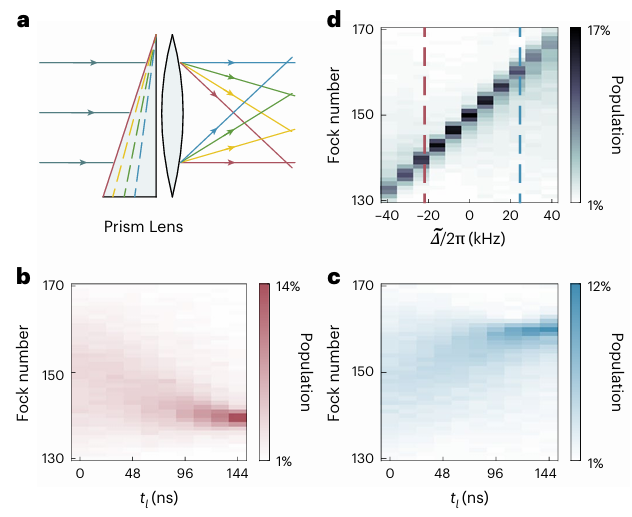
Fig. 3: Newton’s prism experiment in Fock space
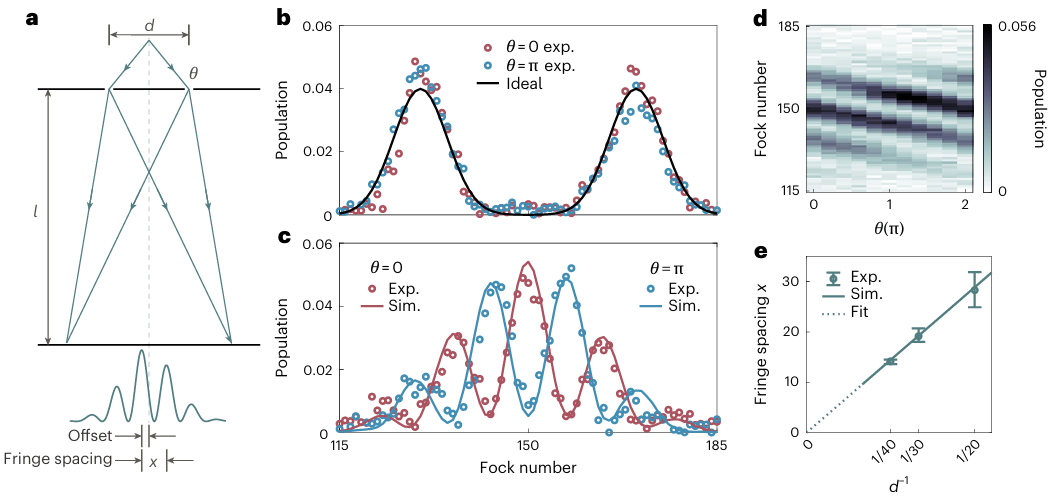
Fig. 4: Young’s double-slit interference in Fock space
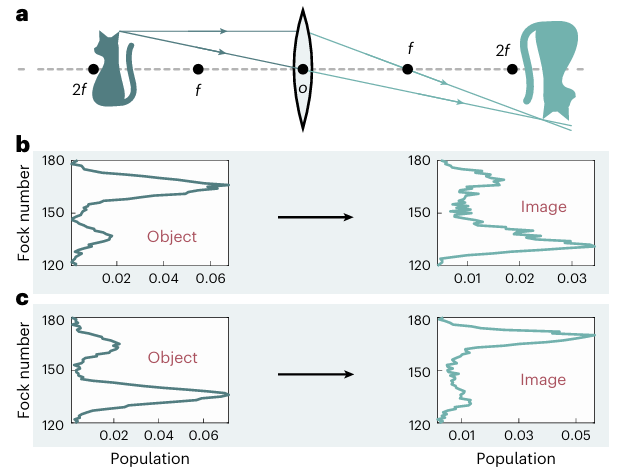
Fig. 5: Imaging in Fock space
Opening New Pathway for Large-Photon-Number Quantum State Manipulation
These experimental results demonstrate that the laws of classical optics are not only applicable to light propagation in real space, but can also serve as an intuitive physical language for the design and manipulation of high-dimensional quantum states.
The significance of this work lies not merely in achieving experimental demonstrations with larger photon numbers, but more importantly in establishing a new paradigm for quantum control. The Fock-space optics framework allows researchers to combine basic elements much like building an optical system, enabling intuitive design of quantum states without the need to solve the full Schrödinger equation each time. This approach holds promise for significantly reducing the complexity of large-scale quantum control, particularly for manipulations at the level of a thousand or more photons, and offers new technological pathways for high-dimensional bosonic quantum computing, quantum error correction, quantum simulation, and quantum metrology.
The research team points out that Fock-space optics is still in its early stages. In the future, more optical elements from classical optics, such as mirrors, gratings, and metasurfaces, are expected to be developed into their corresponding Fock-space counterparts, building an even richer quantum "optical system." At the same time, this framework can be extended to various other bosonic quantum platforms, including mechanical oscillators, cold atoms, and trapped ions, establishing a unified and intuitive language for controlling high-dimensional quantum systems.
Postdoctoral researcher Yifang Xu, Ph.D. student Yilong Zhou, and postdoctoral researcher Ziyue Hua from the Institute for Interdisciplinary Information Sciences, Tsinghua University, are the co-first authors of the paper. Professor Luyan Sun from the Institute for Interdisciplinary Information Sciences, Tsinghua University, and Professor Chang-Ling Zou and Associate Professor Ming Li from the Laboratory of Quantum Information, University of Science and Technology of China, are the corresponding authors. Other contributors include: Ph.D. students Lida Sun, Hongwei Huang, and Lintao Xiao, Assistant Researcher Weiting Wang, and graduate alumnus Jie Zhou from the Institute for Interdisciplinary Information Sciences, Tsinghua University; Associate Researcher Weizhou Cai from the University of Science and Technology of China; and Researcher Haifeng Yu and Associate Researcher Guangming Xue from the Beijing Academy of Quantum Information Sciences.
This work is supported by the Quantum Science and Technology-National Science and Technology Major Project and the National Natural Science Foundation of China.
Paper link: https://www.nature.com/articles/s41567-026-03370-9
Correspondent: Yueliang Mona Jiang
Editor: Xiamin Lv
Reviewer: Yang Yuan